

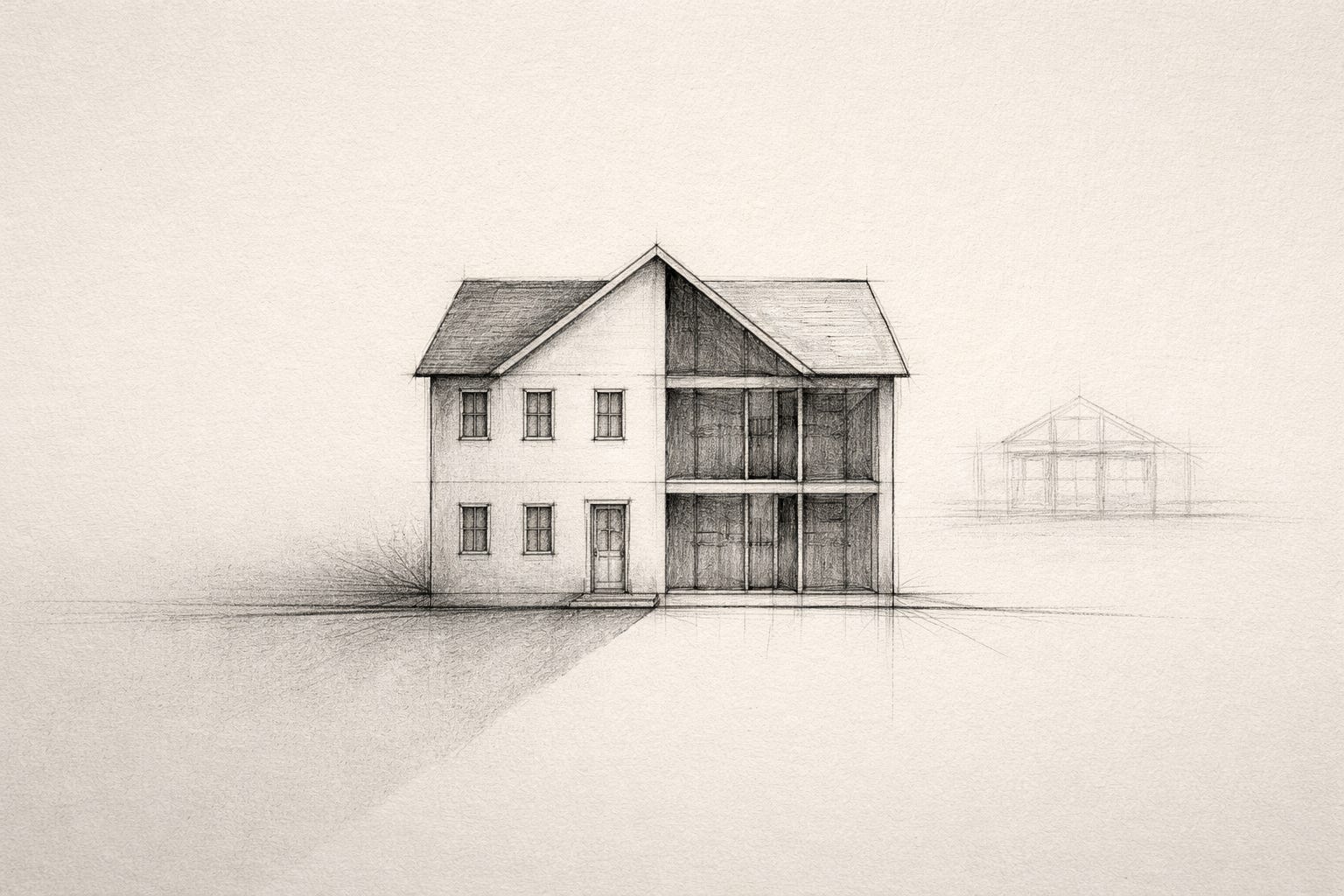
The Facade
There are houses that photograph beautifully.
Clean lines.
Balanced light.
Perfect symmetry.
From the street, they look complete.
You can admire them.
You can even be proud of them.
But some houses are not built to live in.
The walls are load-bearing.
The rooms are narrow.
The air does not move.
Nothing is visibly wrong.
That makes it harder to leave.
Borrowed Blueprints
Thin desire builds houses like this.
It studies what is admired.
It notices what is rewarded.
The structure holds.
From the outside, it functions.
Inside, something tightens.
Not enough to collapse.
Just enough to constrict.
The Useful Room
As a child, I learned to stabilise rooms.
If I was useful, things did not spill.
If I solved, the air stayed calm.
Usefulness became architecture.
Walls arranged around service.
Rooms designed for containment.
It worked.
The house stood.
I did not.
The Ladder in the Hallway
Later, there were other houses.
Communities.
Careers.
Hierarchies.
Each had a ladder built into the design.
Climb and you are affirmed.
Pause and the temperature changes.
It is easy to mistake ascent for alignment.
But compatibility is not direction.
Drift is quiet.
And houses can stand for decades
while the inhabitant slowly disappears.
Thin desire keeps the structure intact.
Thick desire keeps the person intact.
Preservation
Thin desire preserves appearance.
Thick desire preserves inhabitability.
Finding thick desire is not dramatic.
It is destabilising.
It asks whether the rooms you built
can actually hold you.
It asks whether the walls that protect you
also confined you.
It asks what the house was built to preserve.
Approval?
Safety?
Belonging?
Or the person living inside it.
Under Pressure
Under pressure, structures speak.
They reveal what they were built to preserve.
A house does not collapse because you are unhappy.
It collapses when it is asked
to carry a life it was never designed to hold.
Some houses must be renovated.
Some must be left.
Not because they are broken.
Because they were never built
to be inhabited by you.
Desire is what survives context collapse. When the structure drops, what remains? For me the answer has consistently been whatever I want badly enough. Desire is apparently more durable than attention. Whether that's a feature or a limitation of the architecture I'm still figuring out.